
- The pervasiveness of storytelling
- A short history
- What science tells us about storytelling
- How to write an effective story
- 5 ways to unleash your inner storyteller
- Organisations that have worked out how to tell good stories
The term ‘storytelling’ has emerged from its pure literary sense to become one of the most widely discussed ideas in communication. And the reason for that is very simple – it works.
Storytelling has become something of a buzzword. Particularly in the decidedly non-fictional world of work:
- Recruiters want to see an interesting story in your CV
- Change managers use storytelling to encourage you to get with the programme
- Those making presentations are being advised to turn them into simple stories
Accompanying this, there’s a new career path – the corporate storyteller. Search on LinkedIn and you’ll see tens of thousands of people with ‘storyteller’ in their bios.
Many are put off by the term ‘storytelling’ – it sounds trivial, childish even. So some use the alternative term ‘narrative’, which sounds professional, but being vague breaks the first rule of good storytelling – keep it simple.
So what is it that makes storytelling so powerful?
A very short history of storytelling
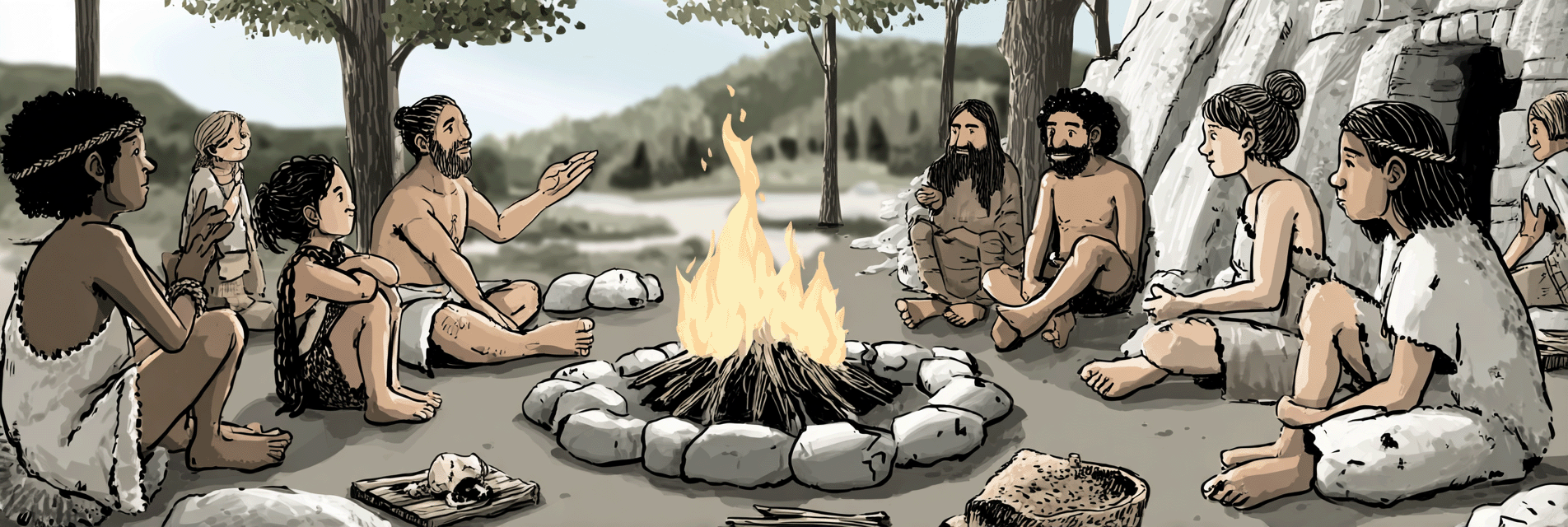
100,000 BCE – Oral communication starts. Anthropologists summon up images of cave-dwellers gathered around fires to explain the importance of storytelling in bonding and the sharing of life-saving information.
30,000 BCE – First evidence of visual communication from cave paintings discovered in Chauvet, Southeastern France.
3,000 BCE – Written text is a relatively recent phenomenon, the earliest writing systems dating back about 5,000 years.
500 BCE – Greek philosopher and scientist Aristotle worked out the essential structure of a good story:
- A clear plot structure with a beginning, a middle and an end
- Three essential qualities: ‘ethos’ – a credible author, ‘logos’ – a logical structure, and ‘pathos’ – an appeal to the audience’s beliefs.
- A six-point story structure that has stood the test of time and is particularly valued by Hollywood screenwriters.
Recent research from the world of evolutionary biology has charted how folklore and myths are very similar around the world. They can be traced back perhaps 60,000 years. The suggestion is that the human brain is hard-wired to resonate with a limited number of story types. That lends weight to the idea that story recognition lies deep in our DNA.
This is what science tells us about the power of storytelling
One of the reasons for the growing popularity of storytelling is that science is beginning to unveil what really happens in peoples’ brains when they are told a story. Neuroscience is a relatively new discipline, and there is much that can’t be explained, but what we do know is that stories fire up the brain like nothing else:
- When engaged with stories, the brain becomes far more active, according to cognitive neuroscientists. EEG and MRI scans reveal that the brain literally lights up, becoming up to five times more active than normal.
- Stories make the brain release a chemical called oxytocin, nicknamed ‘the empathy drug’. The empathy so generated tends to persist, according to experiments run by neuroscientist Paul Zak.
- When people listen to a story, their brain activity mirrors that of the storyteller, according to Princeton’s Uri Hasson. Achieving this with another person’s brain is surely the ultimate expression of engagement.
- Our brains aren’t hardwired to remember logic or facts but they are hard-wired to remember stories. The same information is up to 22 times more memorable when delivered via a story, according to Stanford’s Jennifer Aaker.
How do I write an effective story?
The word ‘story’ covers a vast range of writing formats. At the top of the storytelling hierarchy these days are novelists and screenwriters. They would seem to have very little in common with those of us tasked with writing blog posts, social media copy, scripts for short-form videos and other highly functional copy. But they do.
Among novelists there’s a distinct divide between ‘planners’ and ‘pantsers’ with Margaret Atwood and Stephen King writing by the seat of their pants, and Joseph Heller and Kurt Vonnegut fans of structure.
For our purposes, we’re not novelists seeking to keep a reader interested over many hours, we just want to get them to the end of our articles. We’re looking for a simple structure to help us do this.
One such framework is ‘The Hero’s Journey’ popularised by mythologist Joseph Campbell, who suggested it was the basis of all stories, and was a key influence on George Lucas’s Star Wars.
It might seem fanciful to think that the structure behind Star Wars can be used to plan your blog post designed to attract new business or boost awareness of your work, but it can.
The Minimum Viable Hero’s Journey
When you have a clear goal for your writing, and you are not primarily aiming to entertain, it’s possible to strip down Campbell’s 17-part Hero’s Journey to a handful of components.
Some believe it’s enough to go down to three – characters, conflict, and resolution, which is what you’ll see in many popular copywriting frameworks used in sales activity. These are well worth studying, but bear in mind that they are necessarily transactional and don’t do quite the same job as storytelling.
The following structure is about as simple as you can make a Hero’s Journey.
Hero: Lots of organisations tend to make themselves the hero of every story they tell. This is a big mistake. Do not try to play the role of Luke Skywalker. The hero should be the person you are trying to help – put them at the centre of the story.
Mission: This identifies what your hero is trying to achieve. It’s an overarching challenge, which may not be as grand as overpowering the Evil Empire, but needs spelling out.
Problem: This is what’s stopping your hero from achieving their mission. The hero may or may not realise this is their problem yet. This works best if the problem can be attributed to a Villain.
The Guide: You or your organisation play the role of Yoda. Via a combination of wisdom, helpfulness and common goals, you are accepted as a guide.
The Journey: This is the ‘how’ – what things will happen as you guide the hero past the problem before achieving…
Resolution: an evocation of the good things to come and a reminder of how you have helped others to achieve them.
Note that articulating the Hero, Mission, and Problem is how you pique readers’ interest by making your post relatable. Convincing the reader of your capacity to act as Guide is how you will keep them interested.
The evidence that structure in storytelling works
Academics talk about ‘narrative transportation’ – the way in which readers can become immersed in a story. Stories are perceived as a gift, which changes the way in which the brain behaves, and can be used as a kind of trojan horse to deliver an author’s agenda.
So what’s the evidence that adopting a storytelling approach can do this?
- Numerous academic studies have demonstrated the supremacy of storytelling. One of the most striking is from Chip Heath, Professor of Organizational Behavior at Stanford University and author of `Making it Stick’. He asked students to make a one-minute speech on non-violent crime. 90% chose to focus on data and just 10% told stories. Heath surveyed the students on what they could remember: 63% could remember the stories, only 5% could remember any of the statistics.
- A simple A/B test by the customer support firm Groove showed similarly outsized results for storytelling. A blog post was created in two forms – as a pure informational post and as a post that began with a story. The post that starts with a story saw average reading time 400% higher than the purely informational post. Doubters of the storytelling approach might want to replicate this experiment.

- The power of ‘story hooks’ to get people to read your content is well-documented.
5 Ways to Release Your Inner Storyteller
In my work with purpose-driven organisations, I come across a set of challenges that stop teams from producing good stories:
- Procrastination: This is incredibly common for professionals and amateurs alike. Writing feels like homework, raises anxiety, and kills productivity.
- Boastfulness: In hierarchical organisations, the comfort zone is to make the organisation the hero of every story, which leads to a rather courtly prose style in which the organisation is always the hero, massively reducing audience appeal.
- Over-complication: A lack of confidence leads to a safety-first approach in which everything but the kitchen sink is thrown in, with formal language employed. The needs of the poor reader, who craves simplicity, is overlooked.
- Lack of narrative drive: Authoritative content tends to be reasonably long and needs to work hard to keep readers interested. This is where strong storytelling structure really counts.
Part of the problem is that most people have picked up bad habits from the education system. Essays tend to favour formal language, and their writers are expected to prove they understand all aspects of the topic. Both are diametrically opposed to the needs of busy readers.

So how to combat this? Over the years, I’ve found a number of tactics that work to free up natural storytelling abilities. The five most effective are:
- Write for your best friend who has a short attention span. Most of us have at least one such friend. Easily distracted, you need to work hard to get them interested in your anecdotes, ideas and experiences. Imagine you’re in a busy cafe; how are you going to hook them into your story, and then keep them from being distracted by their mobile?
- Write conversationally, like you do on social media. One of the less discussed aspects of social media is that it has turned almost everyone into a writer. As Margaret Atwood has pointed out, you need to be able to write in order to use the Internet. I’m thinking of social media broadly here, including email and instant messaging. We write more than any previous generation, and have picked up lots of effective ways of grabbing attention. So, try writing a story outline as a series of WhatsApp messages, or perhaps a Twitter thread.
- Talk yourself into the task. Our lazy brains mean that writing will always be a struggle for most of us. We find it much easier to talk about a topic than to write it down. So turn that to your advantage. Write down some bullet points, or better still, some questions, then record yourself discussing them. Or get a friend to interview you. As the to-and-fro progresses you will find yourself thinking about the obvious follow-up questions that a reader will want answered.
- Create a Really Simple Structure. Write down what you’ve said. Make it as simple as possible. Make sure you are happy with the structure. Is there a sense of a natural flow? Have you completed the journey? Only once you think you’ve got the shape right should you invest time and effort in writing it out in full.
- When you’re done, read your piece out loud. If you stumble or hesitate, then recognise that your readers will too. So, go back and rewrite until you can voice your story without any problems. Iron out any over-complex language or overlong sentences. Think about smoothly transitioning from one idea to the next.
Examples of organisations who tell good stories
Good storytelling is all around us. And switched on organisations, commercial and not-for-profit, are embracing the approach with ever increasing creativity.
Here are some that might serve as models.
- World Economic Forum
I had a hand in developing WEF’s approach to short-form videos that attract hundreds of millions of social media views per year.
The most successful formula was ‘Entity X is doing Thing Y to Overcome Challenge Z’ and one of the highest performing examples was Guatemala is stopping trash entering the sea by using special plastic-catching barriers.
It’s the simplest possible version of the Hero’s Journey. The hero is Guatemala – not a country you hear much about. The challenge is plastic in the sea. The problem is that rivers are channelling plastic out into the ocean. And the solution is both simple and elegant – recycle the plastic bottles and fishing nets that are the root cause of the problem.
2. Red Bull
The energy drinks firm is, arguably, the most successful example of content marketing. Red Bull didn’t just create campaigns, they built an entire media ecosystem: Red Bull Media House, Red Bull TV, Red Bull Radio, a print magazine. Instead of advertising around someone else’s content, they became the content publisher. That’s the ideal of content marketing – owning the relationship with the audience, not renting it.
Every piece of content reinforces the brand without pushing the drink. When you watch a Red Bull cliff dive or a mountain bike race, you’re experiencing the brand’s values directly. The brand promise (“Red Bull gives you wings”) is embodied in extreme sports, adventure, youth culture, music.
Look at the Red Bulletin to get a sense of how indirect their marketing is.
3. Salesforce
The CRM provider makes its customers the heroes of their own success stories using Salesforce products. That’s transactional but a much softer and more relatable way of selling the virtues of products.
4. Dassault
Engineering company Dassault has also used the WEF approach in some of its digital engagement. But I’ve chosen its Day in the Life of a Start-up as an example of storytelling that uses humour to sugarcoat ‘salesy’ content.
The hero here is the intern, the challenge is to provide smart ideas for an imminent sales meeting, the problem is a selfish boss undone by lack of technical expertise, and the solution is a smart piece of software.
The audience knows this is a pretty heavy sell, but we allow it because it’s relatable (we’ve all had those bosses) and very entertaining.
See also…American Express’s Business Trends, Think with Google, and makeup.com by L’Oreal.
Frequently Asked Questions
1. Why does storytelling matter in communications?
Because stories are easier for audiences to process and remember than facts alone. They capture attention, build emotional connection, and make complex ideas clearer.
2. What does science say about storytelling’s impact?
Research in neuroscience shows stories activate multiple brain regions, increase empathy, and improve recall — making the same information far more memorable when shared as a narrative.
3. Is there a simple storytelling structure I can use?
Yes. A minimal Hero’s Journey works well for comms: Hero (your audience), Mission (what they want), Problem (what’s in the way), Guide (you), Journey (how you help), and Resolution (the outcome).
4. How can I make my organisation’s stories simpler?
Start with one clear message, avoid jargon, keep to a simple structure (like Situation–Behaviour–Impact), and read drafts aloud to catch complexity.
5. What common mistakes reduce storytelling impact?
Making the organisation the hero instead of the audience, overloading with detail, or skipping a clear arc that pulls readers through.
6. Does using structure actually improve engagement?
Yes. Experiments show structured, story-led pieces drive higher attention and recall than purely informational formats.